
How much does graffiti removal cost? There is no single reliable figure because every job involves a different surface, type of marking, affected area, and access arrangement. A small tag on an accessible metal roller shutter requires a very different treatment from paint absorbed deeply into a large, porous brick façade.
What matters most is what the contractor has included in their formal quotation. Understanding the key cost factors will help you provide accurate information during your enquiry, spot missing items in the scope of work, and compare proposals fairly—without relying on misleading or unsupported national averages.
How Much Does Graffiti Removal Cost?
UK price guides show that removal costs vary widely. Indicative rates include £42–£135 per m² for steam or chemical cleaning, £99–£150 per m² for sandblasting, and £99–£180 per m² for anti-graffiti coatings.
| Example service or job size | Indicative UK price range |
| Steam or chemical cleaning | £42–£135 per m² |
| Sandblasting | £99–£150 per m² |
| Anti-graffiti coating | £99–£180 per m² |
| Small area under 1 m² | £80–£120 total |
| Area of 1–3 m² | £120–£250 total |
| Area of 3–10 m² | £250–£600 total |
| Area over 10 m² | £600–£1,500+ total |
Important: Treat these figures as broad market guides. For a tailored quotation, contact us with photographs, measurements, the surface type, access details, and the finish you need. The sections below explain the factors that can affect the cost.
What Affects the Cost of Graffiti Removal?
Size and Density of the Graffiti
Measurements matter, but square metres never tell the whole story. A broad, lightly marked area may be more straightforward to treat than a smaller patch covered with dense, overlapping paint. Multiple tags across separate elevations can also require extra set-up time and equipment repositioning around the property.
We consider the spread, density, and treatment difficulty together. Clear dimensions and photographs give us a much better starting point than a vague description such as “a small amount of graffiti”.
Surface Material and Condition
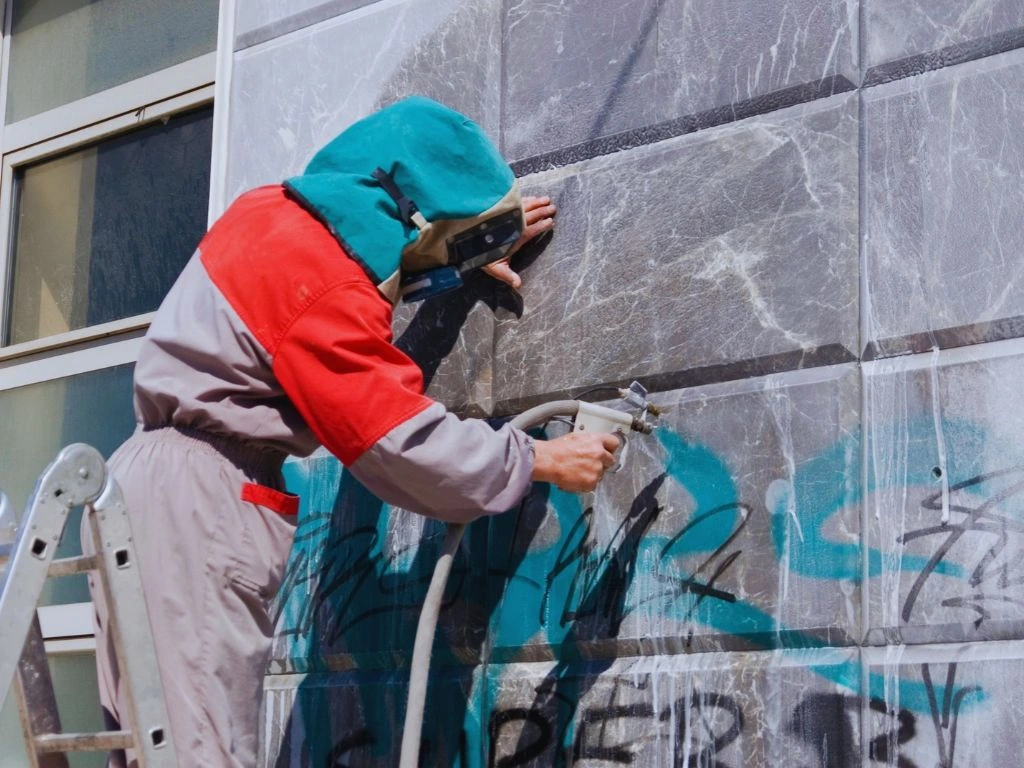
Porous materials like brick, concrete, and render absorb paint or ink deep into their pores and uneven textures. Metal shutters, glass, and other non-porous surfaces behave very differently, while previously painted walls may already have a fragile or weathered finish.
A more forceful approach is not automatically more effective. The method and pressure must be matched precisely to the substrate. Harsh chemicals or excessive pressure can cause permanent surface damage, making a small test patch an essential precaution. This is why specialist commercial cleaning requires careful judgement of the surface condition before work begins. Your quotation should reflect that detailed assessment rather than assuming one treatment fits every wall.
Type and Age of the Markings
Aerosol spray paint, permanent marker ink, and industrial coatings respond differently to treatment. The depth of absorption, the number of layers, and any remaining chemical “shadowing” or staining all dictate the products and time required. Where specialist chemical removers are needed, Health and Safety Executive (HSE) cleaning guidelines highlight that products can pose risks to skin and eyes, requiring appropriate safety controls and protective measures for the task.
While age can play a role, older graffiti should not automatically be assumed to be more expensive to remove. The exact combination of the coating type and the underlying surface provides a far more accurate basis for estimating cost than age alone.
Access and Site Conditions
A ground-level wall beside open parking is significantly easier to plan for than markings situated high above a busy high-street pavement. Restricted parking, secure access points, working at height, and the need to protect passing pedestrians, nearby vehicles, or neighbouring properties all influence the operational scope.
Timing is equally critical for operational premises. Work may need to be scheduled around business opening hours, delivery slots, or peak trading periods. Any out-of-hours or overnight arrangements should be explicitly confirmed with your contractor up front.
Required Finish and Treatment Method
Clients do not always share the same definition of “removed”. One property may simply need the tag broken down so it no longer attracts attention, while a prominent commercial frontage may require complete removal to restore a uniform appearance.
The expected end result directly shapes the scope of work. Our graffiti removal and jet washing service is tailored around the specific surface and commercial environment. Where appropriate, the approach may also incorporate commercial exterior pressure washing if the substrate permits. A professional quotation should always state the intended finish clearly, and full restoration should never be promised before an in-person assessment.
How a Graffiti Removal Quote Is Prepared
A useful enquiry gives the contractor enough context to assess the likely treatment, access requirements, and time involved. When requesting a quote, please provide:
- Clear close-up photographs: Detailed shots showing the specific paint, ink, or spray type.
- Wide-angle photographs: Contextual photos showing the whole affected elevation and surrounding area.
- Approximate dimensions: Estimated width and height of the markings.
- Surface material: Details of the underlying substrate (e.g., brick, stone, render, glass, or metal), if known.
- Property location: Full address and postcode for access planning.
- Height and access details: The height of the markings above ground level and any obstacles, gating, or equipment restrictions.
- Site conditions: Local parking arrangements, pedestrian footfall, or business operating hours.
- Schedule and timeframe: Your target completion date or preferred operational window.
While photographs are invaluable for initial scoping, they cannot always reveal surface porosity, subtle chemical shadowing, or previous coatings. Unless explicitly confirmed as fixed, treat any price based solely on photographs as an initial estimate rather than a final quotation.
We conduct on-site visits prior to issuing a final quote whenever a detailed physical assessment is required. This protects both sides from relying on an imprecise price based only on surface measurements, while ensuring we fully understand the finish you expect and how to carry out the work safely around your property.
What Should Be Included in the Quote?
A professional quotation should be explicit enough for you to understand exactly what you are approving before any work begins. Formats vary, so check that your quote clearly details:
- Labour and scope: A full breakdown of labour and the agreed operational scope.
- Materials and equipment: All specialist treatment products, professional cleaning equipment, and safety equipment.
- Access and height provisions: Any equipment or arrangements required for safe access and working at height.
- Site assumptions: Clear assumptions regarding site access, available utilities, and property working conditions.
- Exclusions and contingencies: Outlined circumstances or unexpected surface conditions that could alter the final price.
- Aftercare: Any follow-up treatment or aftercare where offered.
- VAT status: A clear indication of whether VAT is included in the final figure.
Pay close attention to wording regarding residual staining, chemical shadowing, and additional treatments. If the quote relies on site assumptions, they should be explicitly stated. This is particularly critical for porous stone or previously painted surfaces, where the underlying condition may only become fully visible once the surface markings are removed.
Example Graffiti Removal Cost Scenarios
These examples show why similar enquiries can lead to noticeably different quotations:
- Small tag on a metal shutter: A compact marking on an accessible, non-porous metal roller shutter typically requires little set-up, straightforward treatment and limited preparation.
- Porous brickwork of similar dimensions: Paint absorbed into porous brickwork or natural stone calls for a more delicate, multi-stage approach. A specialist, surface-appropriate treatment and extra care may be needed to avoid damaging mortar joints, even when the area is the same size as the metal shutter example.
- Large commercial frontage: Multiple tags across upper levels of a prominent commercial building require detailed access planning, pedestrian protection, appropriate site controls and potentially out-of-hours scheduling to avoid disrupting customers or daily operations.
- Multiple scattered tags vs one continuous area: Treating several tags across different elevations of one building involves more set-up, masking and equipment repositioning than treating a single continuous area of the same total size.
The lowest price is not always a like-for-like comparison. A cheaper estimate may cover a narrower scope, excluding access provisions, containment, follow-up treatment for shadowing or the more refined finish included in another contractor’s proposal.
How to Request a More Accurate Quote
Start with photographs that show both close-up detail and the wider context. Close-ups help identify the type and density of the paint or ink, while wide-angle shots show the height of the markings, surrounding surfaces, and site access.
Include the precise dimensions, property address, and any operational restrictions. Let the contractor know if the affected area is near customer entrances, parked vehicles, shared public walkways, or active delivery routes. These details are useful whether you need graffiti removal in Hertfordshire or specialist support at commercial premises across Bedfordshire, Cambridgeshire, and North London.
Providing complete information upfront reduces unnecessary back-and-forth and helps the contractor give you a more accurate initial response. For a tailored quotation, send your site photographs, approximate measurements, surface details, and access notes through our contact page.
How to Compare Graffiti Removal Quotes
Always compare the proposed scope of work before comparing the total price. Check the cleaning method, intended finish, access arrangements, exclusions, and what happens if further treatment is required for residual shadowing. Ask whether the proposed approach suits your specific surface material and whether the contractor holds appropriate insurance for the work.
Relevant experience should relate directly to your specific setting and substrate, rather than being presented as a vague claim. Our guide to questions to ask a commercial cleaner can help you assess the wider service, including communication standards, insurance coverage, and scope clarity.
A low quotation with unclear assumptions can quickly become expensive if key requirements are omitted. Conversely, a higher figure may already include necessary access arrangements, surface protection, and follow-up treatment that another proposal leaves out. Put the quotes side by side and compare them on a strict like-for-like basis.
Frequently Asked Questions
Is VAT included in a graffiti removal quote?
That depends on the provider and the wording of the quotation. Always ask for written confirmation rather than assuming that the displayed total includes VAT.
Is there a minimum charge for a small graffiti-removal job?
Some providers apply a minimum charge to cover travel, site set-up, specialist materials, and equipment preparation, though arrangements vary. It is wise to check this before approving a small job and ask exactly what the minimum fee encompasses.
Can graffiti removal be carried out outside normal business hours?
Yes, out-of-hours cleaning can usually be arranged if the contractor and site permit. Be sure to confirm availability, access arrangements, and any potential effect on pricing—particularly where footfall, residents, or delivery schedules make daytime work difficult.
Who pays: the landlord, tenant or managing agent?
Responsibility depends entirely on the lease terms, tenancy agreement, property management contract, and the specific circumstances of the damage. All relevant parties should review their agreements and formally confirm approval before commissioning the work.
How long is a graffiti removal quotation valid?
The contractor sets the validity period, which usually reflects current scheduling, material costs, or site condition. Check the stated expiry date on your quote, and request an updated estimate if the surface condition or scope of work changes in the interim.
Request a Graffiti Removal Quote Today
If graffiti is affecting your commercial premises or managed property, send us clear photographs, approximate measurements, and details of any access restrictions. We’ll review the information, confirm whether an on-site assessment is needed, and prepare a tailored quotation.
For advice or to arrange a one-off clean, contact Principal Cleaning Solutions today. Call 01462 227 000 or email info@principalcleaningsolutions.co.uk. We’ll help make the process straightforward, from your initial enquiry to the handover.