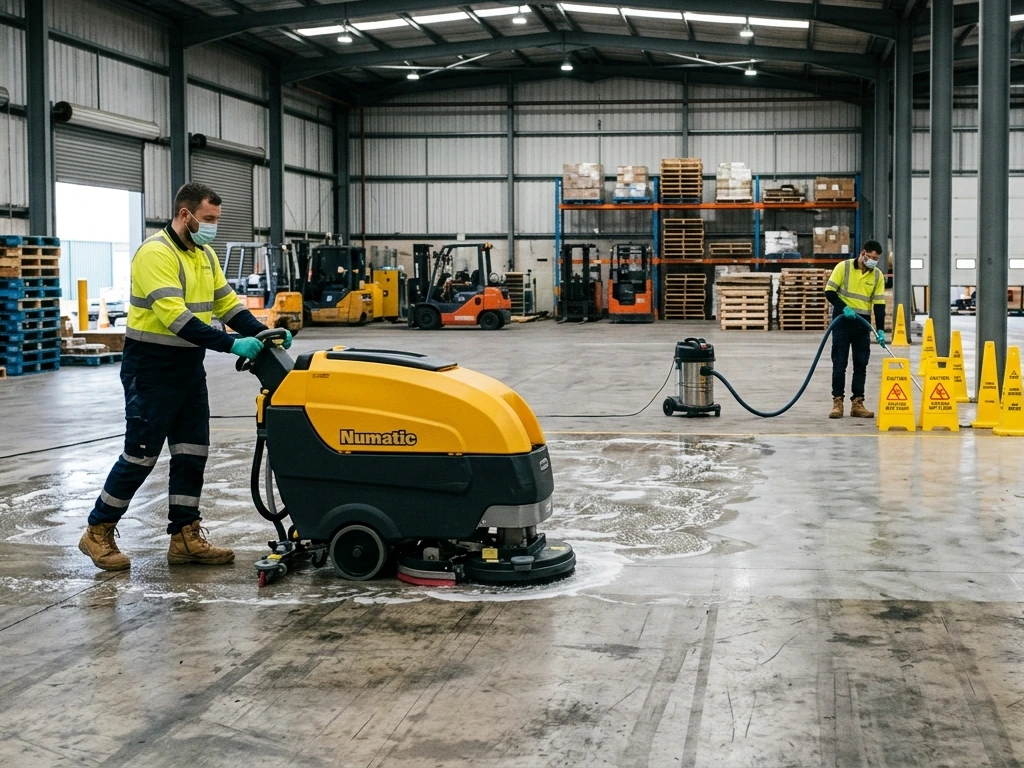

If you own or manage a busy warehouse, factory, or distribution hub, you should know that your floor counts as one of your most precious, hard-working assets beside your machinery and fleet. Industrial floors serve as the literal foundation of your operations, and without a dedicated maintenance strategy, they will eventually succumb to the extreme pressure of daily commercial use and put your business at risk.
Backed by years of industry experience serving clients across North London, Hertfordshire, and the surrounding areas, our team here at Principal Cleaning Solutions understands that future-proofing your business starts by ensuring its floors are well-maintained.
Here is a quick guide about industrial floors, how you can tell they’re failing and what it means for your business if they are, the benefits of well-maintained floors, and how you can work with Principal Cleaning Solutions today to future-proof your business.
What are Industrial Floors
Industrial floors are typically made from reinforced concrete slabs; they are strengthened with steel mesh or fibres and finished with high-durability coatings such as epoxy resins or polyurethane screeds.
They are made to withstand tonnes of cargo, the stress of forklifts and other vehicles, and constant chemical exposure. Although they are not designed to fail—and as concrete is naturally porous—even the strongest industrial floors require sealing and maintenance to keep them resistant to oils, moisture, and other contaminants that could cause them to break from the inside out.
Suggested read: Top 5 Industries That Need Warehouse Floor Scrubbing Services
Signals That Your Industrial Floor is Failing
The signs of a failing industrial floor are often subtle, but learning how to identify them can save your business thousands of pounds in the long run. So, if you notice any of the following, your floor’s structural integrity is likely under threat:
- Concrete Dusting: You can observe a fine, white chalky powder on the surface of your industrial floor, meaning that its top-most layer is disintegrating due to daily use
- Joint Spalling: You can observe cracking, chipping, or breaking around the joints; this is commonly caused by heavy traffic over unmaintained gaps
- Delamination: The protective resin or paint over your industrial floor is peeling, leaving the concrete bare and vulnerable to damage
- Spider-Web Cracks: If you see small, interconnecting cracks in certain parts of your industrial floor, this means that they are struggling to handle the weight of either your cargo or machinery
- Staining: When spills no longer sit on top of the surface and are harder to clean, it means that the protective coating of your industrial floor has failed and these harmful substances are starting to “soak in”
What Happens When Industrial Floors Fail
Ignoring the early warning signs that your floor is failing makes you vulnerable to a suite of structural and financial problems, ranging from accidents to a total breakdown of operations. Take note that what starts as a small crack or a dusty patch can easily escalate into an issue that would require thousands of pounds, days of downtime, and solutions that are far from a simple clean to fix.
Health and Safety Risks
Your industrial floors failing puts your workforce at risk. Uneven surfaces and damaged joints can create trip hazards and could cause heavy machinery to become unstable.
- A single injury claim resulting from poorly maintained industrial floors can lead to massive legal costs
- You risk failing mandatory safety audits if your industrial floors do not meet UK standards
Machinery and Fleet Wear
Forklifts and reach trucks generally rely on industrial floors being perfectly level to be operated efficiently. If your industrial floor is compromised, your machinery will also pay the price.
- Travelling over damaged floors can shred your vehicle tyres in record time
- The vibrations caused by failing industrial floors could lead to premature mechanical failure
- Sensitive computers and other modern machinery could be rattled to the point of failure
Total Operational Downtime
Repairing a failed industrial floor cannot be done while the business is running.
- Resurfacing or deep-filling cracks requires the affected area to be cleared of stock or machinery
- Resins used to fix industrial floors can take days to fully cure before they are ready
- Every day your facility is closed for repairs is a day of lost revenue
Product Contamination and Hygiene Issues
The condition of a business’s industrial floor is crucial, especially for food, pharma, or tech companies.
- Fine particles from disintegrating concrete can settle inside sensitive electronics and put them at risk
- Cracks and pits can serve as a breeding ground for bacteria, and many industry-specific certifications would be revoked if your industrial floors are deemed unhygienic
Massive Capital Expenditure
The cost of a total replacement for industrial floors is astronomically higher than the cost of a regular preventative maintenance programme.
- If the damage reaches the sub-base of your industrial floor, you may have to dig up the original slab and replace it entirely
- A building with failing floors has a lower market value and is much harder to lease
- Having persistent maintenance issues can increase the cost of your insurance
Benefits of a Well-Maintained Industrial Floor
By being proactive rather than reactive, you ensure that your facility remains safe, efficient, and profitable. Some of the core benefits of a well-maintained industrial floor include:
- Extended Lifespan: Regular professional cleaning and maintenance can double the life of your industrial floors
- Enhanced Operational Safety: Level, slip-resistant industrial floors drastically reduce the risk of workplace accidents
- Optimised Performance: Your forklifts and reach trucks will run smoother, use less energy, and require fewer tyre replacements when operating on well-maintained industrial floors
- Reduced Maintenance Costs: Protecting the surface of your industrial floors prevents the deep structural damage that often leads to five-figure repair bills
- Better Brand Image: Clean, well-maintained industrial floors project a message of efficiency and care to visiting clients and auditors
Suggested read: Why Specialist Cleaning Means More To Your Business Than You Think
Why Work With Principal Cleaning Solutions
At Principal Cleaning Solutions, we understand that future-proofing your business starts by ensuring your industrial floors are clean and well-maintained. As a specialist cleaning company large enough to service office buildings and hospitals across Hertfordshire, Bedfordshire, Cambridgeshire, and North London, rest assured that our dedicated team of experienced and trained professionals will act with the urgency and precision needed to ensure your property is pristine, safe, and compliant.
We are also flexible, offering a comprehensive suite of specialist services, including:
- Industrial Hard Floor Maintenance
- Post-Construction Cleaning
- Hazardous Waste Removal & Decontamination
- Crime Scene & Trauma Cleaning
- Void Property and End of Tenancy Cleaning
Frequently Asked Questions (FAQs)
How often should I have my industrial floors professionally cleaned?
The frequency varies depending on the environment, but we generally recommend a professional clean at least every three to six months, or as needed. High-traffic warehouses with constant forklift activity, and manufacturing plants dealing with oils, chemicals, and other substances, may require a monthly check to ensure their floors are slip-resistant, structurally sound, and compliant.
How long do I have to stop production for industrial floor maintenance?
The time largely depends on the size of the area as well as the scope of the work, but rest assured that we will give you a specific timeframe during our consultation process. We aim for zero to minimal downtime for our clients, so our services can be scheduled out-of-hours or even at the weekend to ensure that your business remains operational.
How do failing industrial floors affect my budget for maintenance?
Significantly. A pitted or uneven floor may cause unnecessary stress to your forklift’s tyres or even to the vehicle itself. Keeping your industrial floors level and well-maintained ensures the health of your fleet in the long run.
Future-Proof Your Business with Principal Cleaning Solutions
Neglecting the maintenance of your industrial floors is a risk to your facility’s safety, your vehicles and machinery, and your company’s bottom line. If you need urgent assistance in remediating failing industrial floors or require a specialist team to perform a restorative deep clean of your commercial property, remember that you have a team of experts at Principal Cleaning Solutions who are just one call away.
Reach out to us for more information about our industrial cleaning services. You can get a no-obligation quotation here. You can also email us at info@principalcleaningsolutions.co.uk or call 01462 227 000 if you have any questions.
Let us know how we can help you today!